
When an Orange County condominium association has missed its California SB 326 balcony inspection deadline—or has just issued a $15,000 to $60,000 special assessment for structural wood repairs—unit owners face a critical financial fork: stay and fund the assessment, or sell before the project loses conventional mortgage eligibility. Following Fannie Mae's August 3, 2026 retirement of Limited Condo Reviews (Lender Letter LL-2026-03) and California's SB 410 mandatory disclosure rules, whether your building remains financeable matters far more to your net equity than the dollar size of the repair bill.
Quick answer: Selling an Orange County condominium subject to California’s SB 326 balcony inspection law (Civil Code §5551) requires providing the stamped structural engineer report in your Civil Code §4525 HOA disclosure package under SB 410. Because Fannie Mae and Freddie Mac strictly enforce building-wide SB 326 compliance, condos in associations with overdue inspections or unaddressed structural repairs often lose conventional loan eligibility—forcing sellers to either pay off pending special assessments at closing or market to cash buyers.
Written by Diego Magdaleno, REALTOR® (CA DRE #01952035), Diego & Nauz | 1Vision Real Estate · Reviewed by Nauz Magdaleno, J.D. · Updated November 2026
Fiduciary real estate analysis examining California Civil Code § 5551 (SB 326), SB 410 disclosures, Davis-Stirling assessment rules, and Fannie Mae LL-2026-03 condo lending guidelines.
Concerned About an SB 326 Inspection or HOA Assessment?
Consult directly with Diego Magdaleno to pre-audit your HOA's Form 1076 condo questionnaire, check Fannie Mae warrantability status, and compare selling now vs. staying.
1. Does SB 326 Actually Apply to Your Condo or Townhome?
Before reacting to rumors of a massive balcony assessment, verify whether California Civil Code Section 5551 (SB 326) legally governs your building. SB 326 applies only when all four criteria are met:
- Condominium Legal Classification: The community is legally organized as a condominium project under its recorded CC&Rs. For how condos compare with other attached-housing ownership structures, see our co-op vs. condo ownership guide. Attached townhomes organized as Planned Unit Developments (PUDs) where individual owners maintain their own exteriors are generally exempt.
- Three or More Attached Multifamily Units: Duplexes and detached single-family homes are excluded.
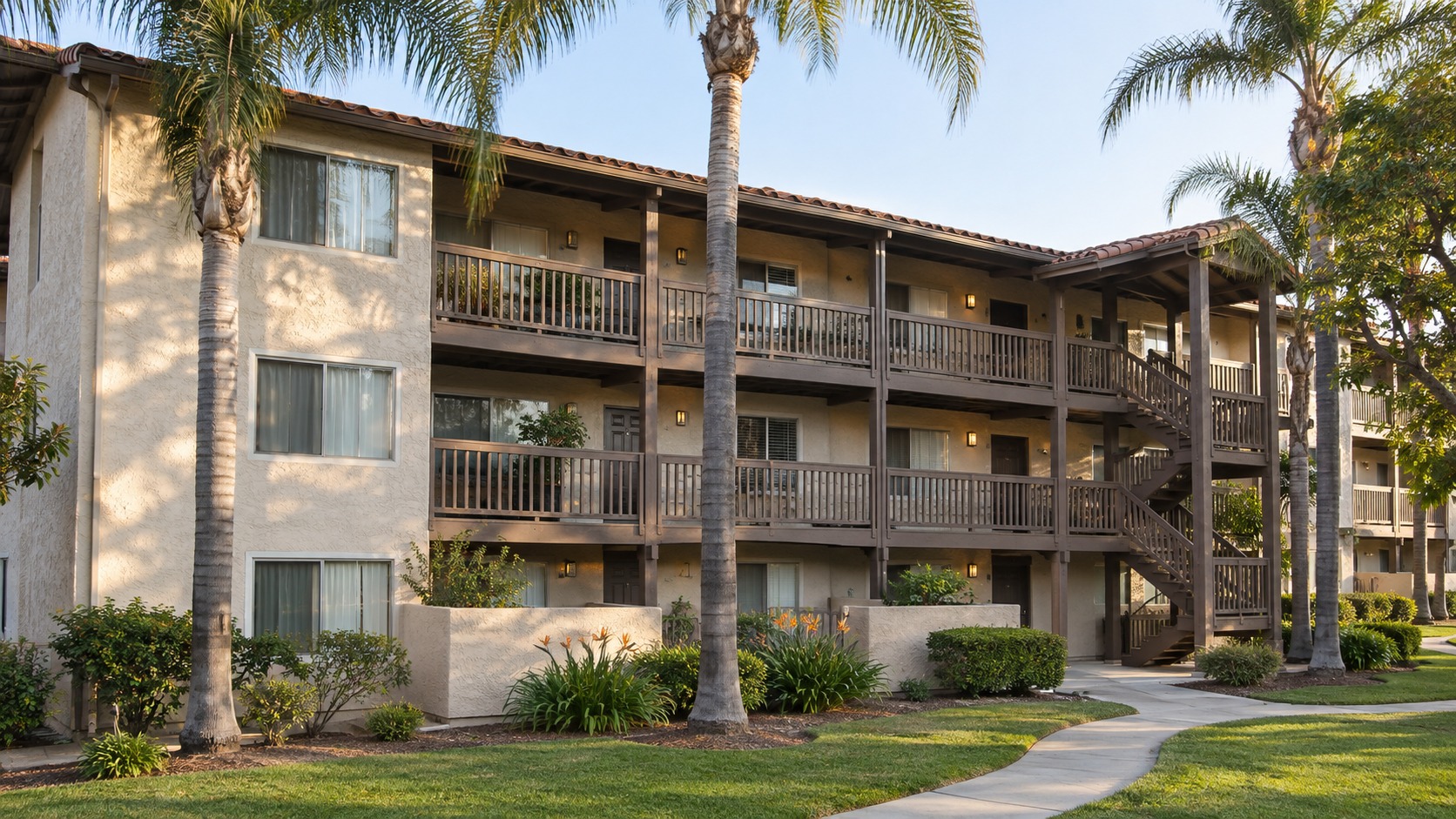
- Wood-Framed Exterior Elevated Elements (EEEs): The building contains balconies, decks, stairways, or walkways elevated more than 6 feet above ground that rely in whole or substantial part on wood or wood-based structural framing. Elements built exclusively of steel, reinforced concrete, or masonry are exempt.
- HOA Maintenance Responsibility: The association—rather than the individual unit owner—holds maintenance responsibility for the elevated structures.
Statutory Deadlines: Buildings permitted prior to January 1, 2020, faced an initial compliance deadline of January 1, 2025 (AB 2579 extended the initial deadline to January 1, 2026 only for apartment buildings under SB 721; condominium HOAs received no extension and are now past their January 1, 2025 deadline). Projects permitted on or after January 1, 2020, must complete their first inspection within six years of receiving their certificate of occupancy.
2. What Happens If Your HOA Missed the SB 326 Deadline?
Many HOA boards and online articles mistakenly state that delinquent condominiums face $100 to $500 per day municipal fines. Those daily statutory penalties belong to Health and Safety Code Section 17973 (SB 721), which regulates apartment buildings—not condominium HOAs.
For Orange County condo owners, the real consequences of a missed SB 326 inspection are immediate market and legal paralysis:
- Conventional Mortgage Disqualification: Fannie Mae and Freddie Mac underwriters automatically block loans in buildings with overdue required structural inspections.
- Master Insurance Non-Renewal: Commercial property carriers routinely decline to renew master policies for associations lacking a current structural safety certification.
- Davis-Stirling & Negligence Liability: Boards face owner enforcement lawsuits and heightened negligence exposure if an uninspected walkway fails.
- Qualified Inspectors Only: Under Civil Code § 5551 (as amended by AB 2114 in July 2024), inspections must be conducted by a licensed structural engineer, civil engineer, or architect. General contractors and standard home inspectors cannot issue valid SB 326 reports. If an engineer discovers an immediate life-safety hazard, the HOA must close the area the same day and notify local city code enforcement within 15 days.
3. Can the HOA Board Levy a Special Assessment Without an Owner Vote?
Under California's Davis-Stirling Common Interest Development Act, an HOA board’s authority to impose a special assessment depends on the dollar amount relative to the annual budget:
- The 5% Cap (No Vote Required): A board can unilaterally levy special assessments up to 5% of the association's budgeted gross expenses for that fiscal year without a membership vote.
- Membership Vote Required Above 5%: Under Civil Code Section 5605, any special assessment exceeding 5% requires approval by a majority of a quorum (more than 50% of all voting members).
- The Section 5610 Emergency Exception: A board can bypass the 5% cap without a vote only for strict statutory emergencies—such as court-ordered expenses, urgent utility repairs when reserves are insufficient, or extraordinary structural repairs that could not have been reasonably foreseen when adopting the annual budget (backed by formal written board findings).
Owner Payment Plan Rights (Civil Code § 5665): Owners must receive written notice 30 to 60 days before an assessment is due. If you cannot pay a lump sum, you have the statutory right to submit a written payment plan request within 15 days of the postmark on the notice, and the board must meet with you in executive session within 45 days to consider the request.
4. Assessment Cost Ranges & Comparing Payment Options
Across Southern California, SB 326 balcony and walkway repair assessments typically range from $10,000 to $60,000 per unit, with severe coastal waterproofing failures exceeding $100,000 per door. If your association finances the project through a commercial HOA bank loan, the interest premium dramatically inflates the true cost:
| Funding Strategy | Late 2026 Rate Benchmark | Fiduciary Pros, Cons & Resale Impact |
|---|---|---|
| Cash Lump-Sum Payment | 0% Interest | Lowest total cost; eliminates ongoing assessment liens when selling. |
| Association Commercial Bank Loan | ~8.0% Fixed (7–10 Yrs) | Adds ~46% total interest cost; raises monthly HOA dues for a decade, squeezing future buyers' DTI. |
| Individual HELOC | ~7.49% to 8.47% Variable | Preserves cash liquidity; must be opened before listing on the MLS. |
| Fixed Home Equity Loan | ~8.66% Fixed | Predictable monthly payment; paid off directly out of escrow proceeds upon sale. |
Note: Benchmark figures reflect national November 2026 lender surveys alongside a ~7.18% 30-year fixed conforming mortgage baseline. Obtain written quotes for your specific equity tier.

5. How Fannie Mae's August 2026 Condo Rules Impact Resale & Financing
On August 3, 2026, Fannie Mae and Freddie Mac officially retired Limited and Streamlined Condo Reviews for attached projects containing more than 10 units (Lender Letter LL-2026-03). Virtually all conventional condo buyers must now clear Full Project Review, exposing association finances and deferred maintenance to strict underwriting audits.
Your building will be flagged as non-warrantable (ineligible for conventional loans) if any of the following conditions exist:
- Overdue Structural Inspections: A required SB 326 inspection has not been completed.
- Unfunded or Incomplete Critical Repairs: Active or planned special assessments for uncompleted critical structural repairs, or unfunded critical repairs exceeding $10,000 per unit within 12 months.
- Insufficient Reserve Funding: Annual reserve allocations below 10% of budgeted assessment income (increasing to 15% effective January 4, 2027) unless supported by an acceptable non-baseline reserve study. Note that Fannie Mae no longer accepts "baseline funding" reserve studies.
- High Owner Delinquency: More than 15% of total units are 60 or more days delinquent on regular dues or special assessments.
Sources: Fannie Mae’s March 18, 2026 announcement of LL-2026-03 and Selling Guide B4-2.1-03, Ineligible Projects (no unaddressed critical repairs). Confirm current terms with your lender before relying on any threshold.
Why a Seller Credit Cannot Fix Non-Warrantability: Offering to credit the buyer $25,000 at closing to pay off your unit's share of an assessment does not cure project-level ineligibility. Until building-wide critical structural repairs are completed and signed off, conventional lenders will reject the entire complex, restricting your buyer pool to all-cash investors or Non-QM/portfolio borrowers putting 15% to 25% down at 1% to 2% higher interest rates.
Is Your Condo Building Eligible Under Fannie Mae's New Rules?
Before listing, our team audits your HOA's reserve budget, Form 1076 condo questionnaire, and SB 326 status with local underwriters so you know your true buyer pool upfront.
Before you go live on the MLS, we review solar UCC-1 filings, HOA §4525 and SB 326 status, and fire-zone insurance quotes so surprises surface before escrow, not during it.
6. Mandatory SB 410 Disclosures: What You Must Hand Buyers in 2026
Effective January 1, 2026, California Senate Bill 410 amended Civil Code Section 4525 to mandate that condominium sellers deliver the association's most recent SB 326 exterior elevated element inspection report directly to the buyer inside the statutory HOA disclosure packet.
In addition, you must disclose any missing inspection, pending special assessment, or board discussion of structural repairs on your Transfer Disclosure Statement (TDS) and Seller Property Questionnaire (SPQ). Order the complete Section 4525 HOA packet ($100 to $400) before going live on the MLS—including 12 months of board minutes, the current reserve study, master insurance summary, and Form 1076 questionnaire responses. Study our complete California seller disclosures timing guide to prevent buyer cancellation loopholes.
Primary sources: SB 410 (Stats. 2025, ch. 516), Civil Code §4525, and the California Department of Real Estate’s guidance on CID disclosures.
7. How HO-6 Interior Coverage & Master Policy Deductibles Affect Closing
Under Fannie Mae Lender Letter LL-2026-03 (effective for loan applications dated on or after July 1, 2026), condo buyers face strict individual HO-6 ("walls-in") insurance requirements:
- Matching Master Deductibles: The buyer's individual HO-6 policy must provide coverage at least equal to full interior unit restoration cost or the master association policy's per-unit deductible, whichever is higher.
- HO-6 Deductible Cap: Unit-owner deductibles cannot exceed the greater of 5% or $2,500.
- Wildfire Master Policy Gaps: Across Orange County hillside associations, master wildfire deductibles frequently run $50,000 to $100,000+ per occurrence. Furthermore, HOAs forced into the California FAIR Plan Commercial High Value program face a $20 million per-building limit—requiring supplemental Difference in Conditions (DIC) master wraps to satisfy Fannie Mae's 100% replacement cost rule.

8. Decision Framework: Sell Now, Stay Through Repairs, or Move Up?
Evaluate these four financial variables to decide whether selling prior to construction or staying through the assessment protects your wealth:
- Current Project Warrantability: If your building currently passes Full Project Review because repairs have not yet been formally declared critical or overdue, selling now captures the largest pool of conventional buyers before the window closes.
- Existing Mortgage Rate Lock: If you hold a 2.75% to 3.5% fixed mortgage on your condo, trading into a ~7.18% replacement mortgage creates an immediate monthly payment jump that may exceed a $20,000 special assessment amortized over several years.
- Move-Up Price Spread: According to late-2026 market data, Orange County's condo/townhome median sits near $790,000, while Central OC single-family residences trade between $1.05M and $1.48M+. Ensure your net equity bridges the down payment gap cleanly.
- Concurrent Transaction Timing: If buying a replacement home simultaneously, review our guide to buying and selling at the same time in Orange County, calculate your net cash with our seller net proceeds breakdown, and check your Section 121 capital gains exclusion.
9. Move-Up Considerations: Old Towne Orange vs. Floral Park
Many condo owners looking to escape HOA special assessments target fee-simple historic single-family homes in Central Orange County—which eliminate HOA dues but carry municipal preservation rules:
- Old Towne Orange: Exterior alterations require Design Review Committee (DRC) approval, adding 14 to 22 weeks and ~10% to 15% in construction compliance costs. Additionally, the City of Orange paused new Mills Act property tax contracts until at least April 2027, meaning only homes with existing recorded contracts carry the tax reduction. Review our Old Towne Orange historic home guide.
- Floral Park (Santa Ana): Retains an active Mills Act application program that can significantly lower annual property taxes for qualifying character homes.

10. Action Checklist: What to Collect From Your HOA This Week
Complete these seven steps before setting a list price or signing a listing agreement:
- Verify Legal Classification in CC&Rs: Confirm whether your unit is a condominium project or an exempt Planned Unit Development (PUD).
- Request the SB 326 Report & Board Minutes: Obtain the latest engineer-stamped balcony inspection report and the trailing 12 months of HOA board meeting minutes.
- Audit Reserve Contributions: Check whether the association allocates at least 10% of annual budgeted assessments to reserves (and is prepared for the 15% Fannie Mae threshold on January 4, 2027).
- Check Owner Delinquency Rates: Confirm that fewer than 15% of units are 60+ days behind on regular or special assessments.
- Inspect the Master Insurance Summary: Verify 100% replacement cost coverage and check the per-unit deductible amount.
- Compare Funding Quotes: Obtain written HELOC or equity loan quotes if a special assessment is pending.
- Build a Realistic Escrow Schedule: Pre-vetted condo escrows close in 30 to 35 days, while buildings requiring manual project review take 45 to 60 days. Review our Orange County escrow timeline and our diagnostic on why Orange County homes aren't selling.
11. Frequently Asked Questions
When is the next SB 326 balcony inspection due in California?
Under California Civil Code Section 5551, SB 326 inspections are required at least once every nine years. For condominium associations that met the initial January 1, 2025 deadline, the next mandatory inspection cycle deadline is January 1, 2034.
Can a seller credit fix a condo that failed Fannie Mae's Full Project Review?
No. If an association has incomplete building-wide critical structural repairs, an overdue SB 326 inspection, or insufficient reserves, offering a seller credit for your unit's share of an assessment does not cure project-level loan ineligibility. Conventional lenders will still reject the building until structural repairs are completed.
Can an HOA board pass a special assessment for SB 326 repairs without a vote?
A board can levy special assessments up to 5% of the association's budgeted gross annual expenses without a vote. Above 5%, Civil Code Section 5605 requires a majority vote of a quorum of members unless the board documents a narrow statutory emergency under Civil Code Section 5610.
What did California SB 410 change for condo sellers in 2026?
Effective January 1, 2026, SB 410 requires condominium sellers to include the association's most recent SB 326 exterior elevated element inspection report inside the mandatory Civil Code Section 4525 HOA disclosure packet delivered to buyers.
What happens if an SB 326 engineer finds an immediate safety hazard during escrow?
If an inspector identifies an immediate threat to occupant safety, the HOA must restrict access to the affected balcony or walkway the same day and notify local code enforcement within 15 days. Mortgage lenders will immediately classify the project as ineligible until repairs are completed and certified.
Plan Your Orange County Condo Sale With Local Specialists
Diego Magdaleno has successfully closed over 460 residential transactions across Central Orange County since 2012. Supported by Nauz Magdaleno, JD, the 1Vision team audits HOA reserve studies, SB 326 disclosures, and Fannie Mae warrantability standards across Orange, Tustin, Villa Park, and Santa Ana.
Diego Magdaleno · CA DRE# 01952035 | 1Vision Real Estate · CA DRE# 02051216
Headquarters: 625 The City Drive S, Suite 400, Orange, CA 92868
Book a Confidential Condo & SB 326 Strategy Call with Diego
Select a convenient date and time to review your HOA's SB 326 report, evaluate lender warrantability, and compare selling now vs. staying.